
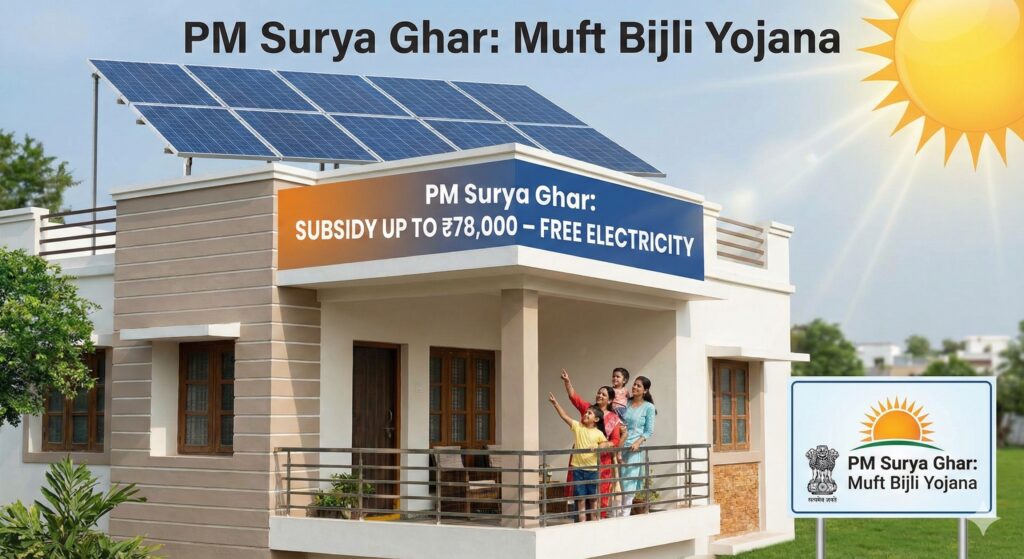
PM Surya Ghar Yojana 2026: The Ultimate Guide to ₹78,000 Subsidy & Zero Electricity Bills
By CryptoEmotion Team | Last Updated: February 10, 2026
Imagine receiving an electricity bill that says “Amount Due: ₹0”. In fact, imagine the electricity company paying you money every month. This is not a dream; this is the reality for over 28 Lakh Indian households who have already enrolled in the PM Surya Ghar Yojana 2026.
The PM Surya Ghar: Muft Bijli Yojana is arguably the most ambitious financial scheme launched by the Government of India. The goal is simple: install rooftop solar panels in 1 Crore households and provide up to 300 units of free electricity every single month.
But with great schemes come great confusion. Agents are spreading misinformation about “Free Solar Panels” (they are not 100% free), and banks are confusing customers about loan interest rates.
In this exhaustive 3,000-word guide, we will decode every single aspect of the PM Surya Ghar Yojana 2026. From the latest subsidy charts to the hidden installation costs that vendors won’t tell you—this is the only guide you will ever need.
What is PM Surya Ghar Yojana 2026?
The PM Surya Ghar Yojana 2026 (officially known as PM Surya Ghar: Muft Bijli Yojana) is a Central Government scheme managed by the Ministry of New and Renewable Energy (MNRE). Unlike previous schemes where the subsidy process was slow and offline, this new version is Direct Benefit Transfer (DBT) based. This means the subsidy money comes directly into your bank account within 30 days of installation.
Key Highlights of the Scheme (2026 Update)
-
Objective: To reduce the electricity bill of middle-class and poor households to zero.
-
Target: 1 Crore Households by 2027.
-
Subsidy Amount: Up to ₹78,000 fixed subsidy.
-
Electricity Benefit: Free 300 units/month (approx. ₹15,000 – ₹18,000 savings per year).
-
Loan Facility: Collateral-free loans at low interest rates (7%) from top banks like SBI and Canara Bank.
The PM Surya Ghar Yojana 2026 is not just about saving money; it is about energy independence. Once you install this system, you are no longer affected by rising electricity tariffs for the next 25 years.
PM Surya Ghar Yojana 2026 Subsidy Structure (Official Rates)
Many people are searching for “How much subsidy will I get?” The rules have changed slightly since the launch. In 2026, the government follows a Fixed Subsidy Model based on the capacity of the system you install.
Here is the official breakdown for PM Surya Ghar Yojana 2026:
| System Capacity | Total Estimated Cost (Avg) | Government Subsidy | You Pay (Approx) |
| 1 kW | ₹50,000 – ₹60,000 | ₹30,000 | ₹20,000 – ₹30,000 |
| 2 kW | ₹1,00,000 – ₹1,10,000 | ₹60,000 | ₹40,000 – ₹50,000 |
| 3 kW | ₹1,45,000 – ₹1,55,000 | ₹78,000 | ₹67,000 – ₹77,000 |
| Above 3 kW | ₹2,00,000+ | ₹78,000 (Fixed) | ₹1,22,000+ |
Important Analysis of the Subsidy Table
-
The “Sweet Spot” is 3 kW: If you install a 3 kW system, you get the maximum subsidy of ₹78,000. This covers nearly 50-60% of your total cost.
-
Above 3 kW Rule: Even if you install a 5 kW or 10 kW system under the PM Surya Ghar Yojana 2026, the subsidy remains capped at ₹78,000. The government is prioritizing small households, not large villas.
-
Group Housing Societies: For Resident Welfare Associations (RWAs), the subsidy is different. They get ₹18,000 per kW for common facilities (like EV charging, lift power, lighting) up to 500 kW.
Eligibility Criteria for PM Surya Ghar Yojana 2026
Before you open the portal to apply, you must ensure you are eligible. The rejection rate for PM Surya Ghar Yojana 2026 applications is around 15% because people fail to meet basic criteria.
1. Who Can Apply?
-
Citizenship: You must be an Indian citizen.
-
Ownership: You must own the house where the solar panels will be installed. Tenants cannot apply directly (the landlord must apply).
-
Electricity Connection: You must have a valid electricity connection in your own name. The name on the electricity bill, Aadhaar card, and Bank Account must match exactly.
-
Roof Rights: If you live in an apartment, you need “Roof Rights” or permission from the society. For independent houses, the roof should be concrete and shadow-free.
2. Who Cannot Apply?
-
Commercial Buildings: Offices, factories, and shops are not eligible for the residential subsidy under PM Surya Ghar Yojana 2026.
-
Previous Beneficiaries: If you have already taken a solar subsidy from the Central Government in the past, you cannot apply again for the same property.
-
Rented Properties: Tenants with electricity bills in the landlord’s name cannot apply.
Documents Required for PM Surya Ghar Yojana 2026
The PM Surya Ghar Yojana 2026 process is 100% digital. You do not need to visit any government office. However, you need soft copies (PDF/JPG) of the following documents ready on your phone or laptop.
-
Electricity Bill: Latest bill (not older than 3 months). It should show your “Consumer Number” clearly.
-
Aadhaar Card: Must be linked to your mobile number for OTP verification.
-
Bank Passbook / Cancelled Cheque: This is crucial. The subsidy of ₹78,000 will be transferred to this account. Ensure the account is active and KYC compliant.
-
Passport Size Photo: Recent photograph of the applicant.
-
Roof Ownership Proof: (Only in specific cases) Property tax receipt or registry copy if the address on the Aadhaar and Electricity bill differs significantly.
Step-by-Step Guide: How to Apply Online for PM Surya Ghar Yojana 2026
Applying for the PM Surya Ghar Yojana 2026 is a 6-step process. Follow this guide carefully to avoid rejection.
Step 1: Registration on National Portal
-
Visit the official website:
https://pmsuryaghar.gov.in -
Click on “Apply for Rooftop Solar”.
-
Select your State (e.g., Maharashtra, Uttar Pradesh).
-
Select your Electricity Distribution Company (DISCOM) (e.g., MSEDCL, UPPCL, TATA Power).
-
Enter your Electricity Consumer Number.
-
Enter Mobile Number and Email. Verify with OTP.
Step 2: Login and Submit Application
-
Login with your Consumer Number and Mobile Number.
-
Fill in the form: Name, Address, Category (General/SC/ST).
-
Enter the Proposed Solar Plant Capacity (e.g., 3 kW).
-
Upload your latest Electricity Bill.
-
Click Submit.
Step 3: Feasibility Approval (The Waiting Period)
-
Once you submit, your application goes to your local DISCOM (Electricity Board).
-
They will check if the local transformer has the technical capacity to handle your solar export.
-
Time taken: Usually 2 to 7 days.
-
You will receive an approval email/SMS. Once you get this, you can proceed to installation.
Step 4: Choose a Vendor and Install
-
Crucial Step: You cannot hire a local electrician. You MUST choose a vendor registered with the MNRE.
-
On the PM Surya Ghar Yojana 2026 portal, go to “Search Vendor” and select one in your city.
-
Sign an agreement with them.
-
The vendor will install the solar panels, inverter, and mounting structure.
-
Payment: You pay the vendor the full amount minus the subsidy? NO. In most cases, you pay the full amount (or take a loan), and the subsidy comes to you later. Some vendors may offer a “net deduction” model, but be careful with this.
Step 5: Net Meter Installation
-
After installation, the vendor will submit the “Work Completion Report” on the portal.
-
The DISCOM officers will visit your home to install a Net Meter. This meter records two things:
-
Import (Electricity you take from the grid).
-
Export (Electricity you give to the grid).
-
-
Once the Net Meter is live, they will generate a “Commissioning Certificate”.
Step 6: Claim Your Subsidy
-
Login to the PM Surya Ghar Yojana 2026 portal again.
-
Upload the Commissioning Certificate and your Cancelled Cheque.
-
The subsidy amount (e.g., ₹78,000) will be credited to your bank account within 30 days.
Solar Loan for PM Surya Ghar Yojana 2026: Interest Rates & EMI
Not everyone has ₹1.5 Lakhs lying around to pay upfront. To make the PM Surya Ghar Yojana 2026 accessible, the government has tied up with all major banks to offer “Solar Loans”.
Top Banks Offering Solar Loans (Feb 2026)
| Bank Name | Scheme Name | Interest Rate (p.a.) | Max Tenure |
| SBI (State Bank of India) | Surya Ghar Loan | 7.00% – 8.25% | 10 Years |
| Canara Bank | Canara Solar | 7.25% – 8.50% | 10 Years |
| Union Bank of India | Union Solar | 7.40% – 8.00% | 10 Years |
| Bank of Baroda | Baroda Sun | 7.60% – 8.55% | 10 Years |
Special Features of PM Surya Ghar Loans
-
No Collateral: For loans up to ₹2 Lakhs (which covers a 3kW system), you do not need to mortgage your house or provide gold as security.
-
Low Down Payment: Banks finance up to 90% of the project cost.
-
Low Interest: The interest rates are linked to the Repo Rate and are much cheaper than Personal Loans (which are 12-14%).
Loan EMI Calculator (Example for 3 kW System)
Let’s assume you install a 3 kW system costing ₹1,50,000.
-
Loan Amount: ₹1,00,000 (You pay ₹50k from savings or adjust subsidy later).
-
Interest Rate: 7%.
-
Tenure: 5 Years.
-
Monthly EMI: Approx ₹1,980.
The Magic: Your electricity bill savings will be approx ₹3,000/month. So, the savings pay for the EMI, and you still have ₹1,000 extra in your pocket!
Technical Guide: Which Solar Panels to Choose?
When applying for PM Surya Ghar Yojana 2026, your vendor will ask you: “Which panel do you want?” Don’t be clueless. Choosing the wrong panel can reduce your electricity generation by 20%.
1. Monocrystalline PERC (Highly Recommended)
These are the black-colored panels you see on modern roofs.
-
Efficiency: High (20-22%).
-
Performance: Works well even in low light (cloudy days or evenings).
-
Cost: Slightly higher, but worth it.
-
Verdict: Always insist on Mono PERC panels for PM Surya Ghar Yojana 2026.
2. Polycrystalline (Avoid)
These are the old blue-colored panels.
-
Efficiency: Low (15-17%).
-
Performance: Poor in low light. Needs more roof space.
-
Verdict: Do not accept these unless you have a huge roof and a very tight budget.
3. Bifacial Panels (The Premium Choice)
These panels generate power from the front and the back (from reflection).
-
Verdict: Only buy these if you paint your roof white or have white tiles. Otherwise, stick to Mono PERC.
The Inverter
The inverter is the brain of the system. For PM Surya Ghar Yojana 2026, ensure your inverter has Remote Monitoring (Wi-Fi). This allows you to check on your phone how many units were generated today. Top brands include Growatt, Solis, and Enphase (Micro-inverters).
Cost vs. Benefit Analysis (ROI): Is it Worth It?
Let’s do the financial math for a typical Indian middle-class family considering the PM Surya Ghar Yojana 2026.
Scenario:
-
Family: 4 Members (2 ACs, Fridge, TV, Washing Machine).
-
Current Bill: ₹3,500 per month (Average).
-
System Installed: 3 kW.
Investment:
-
Total Cost: ₹1,50,000.
-
Subsidy Received: ₹78,000.
-
Net Cost: ₹72,000.
Returns:
-
Generation: 12 Units/day = 360 Units/month.
-
Bill Savings: 360 Units x ₹8/unit = ₹2,880 per month.
-
Yearly Savings: ₹34,560.
Payback Period:
-
₹72,000 (Net Cost) ÷ ₹34,560 (Yearly Saving) = 2.08 Years.
Conclusion: You recover your entire investment in just 2 years. Since solar panels have a life of 25 years, you get Free Electricity for the next 23 years. There is no other financial instrument (FD, Stocks, Gold) that gives this kind of tax-free return.
Common Problems & How to Solve Them
While the PM Surya Ghar Yojana 2026 is excellent, users face some on-ground challenges. Here is how to tackle them.
Problem 1: Vendor Overcharging
Some vendors quote ₹2 Lakhs for a 3 kW system, claiming “High Quality”.
-
Solution: The “Benchmark Cost” is approx ₹50,000/kW. Do not pay more than ₹1.60 Lakhs for a 3 kW system. Get quotes from 3 different vendors before signing.
Problem 2: Delay in Subsidy
“I applied 2 months ago, but subsidy hasn’t come.“
-
Solution: Check if the vendor uploaded the “Commissioning Certificate” correctly. Often, the bank account name and the applicant name have a spelling mismatch (e.g., “Kumar” vs “Kr.“). Correct it on the portal immediately.
Problem 3: Roof Strength
“My roof is old.“
-
Solution: Solar panels weigh about 10-15 kg per sq. meter. If your roof is very old or made of weak asbestos sheets, you might need to reinforce the structure. This cost is extra and not covered in the standard package.
Problem 4: Shadow Issues
“My neighbor has a 2-storey house casting a shadow.“
-
Solution: Solar panels need shadow-free sunlight from 9 AM to 4 PM. If you have permanent shadow, do not install the system. You will not get the desired generation, and your ROI will fail.
State-Wise Links & Helpline Numbers
The PM Surya Ghar Yojana 2026 is a central scheme, but it is implemented by state DISCOMs.
-
Helpline Number: 15555 (Toll-Free National Helpline).
-
Email: support.pmsuryaghar@gov.in
| State | DISCOM Name | Website Key |
| Maharashtra | MSEDCL (Mahadiscom) | mahadiscom.in |
| Uttar Pradesh | UPPCL | uppcl.org |
| Gujarat | GUVNL / DGVCL | https://www.google.com/search?q=guvnl.com |
| Tamil Nadu | TANGEDCO | tangedco.gov.in |
| Karnataka | BESCOM | bescom.co.in |
| Delhi | BSES / Tata Power | bsesdelhi.com |
Frequently Asked Questions (FAQ)
Here are the most common questions about PM Surya Ghar Yojana 2026.
1. Is the PM Surya Ghar Yojana 2026 only for the poor?
No. The scheme is open to all residential households, including the middle class and upper middle class. As long as you have a roof and an electricity connection, you can apply.
2. Can I install a 5 kW system?
Yes, you can install a 5 kW or even 10 kW system. However, under the PM Surya Ghar Yojana 2026, the subsidy is capped at the 3 kW level (₹78,000). You will not get extra subsidy for the capacity above 3 kW.
3. What happens if I generate more electricity than I use?
This is where Net Metering comes in. If you generate 400 units but consume only 300 units, the extra 100 units are exported to the grid. The electricity board will give you a “Credit” for these units, which can be adjusted in future bills (e.g., during monsoon when generation is low). Some states even pay you cash for excess units at the end of the year.
4. Is this scheme applicable for shops or factories?
No. The PM Surya Ghar Yojana 2026 is strictly for the “Residential Sector”. Commercial and Industrial sectors have different schemes (usually tax depreciation benefits, but not direct subsidy).
5. Can I get the subsidy if I install it myself?
No. You strictly have to use an Empanelled Vendor registered on the National Portal. DIY installations or installations by non-registered local electricians are eligible for Net Metering but NOT for the subsidy.
6. Do I need batteries?
Not necessarily. The PM Surya Ghar Yojana 2026 promotes “On-Grid” systems which work without batteries. This is cheaper and maintenance-free. Batteries are only needed if you face frequent power cuts and want backup (Hybrid System), but batteries increase the cost by ₹50,000+.
Conclusion
The PM Surya Ghar Yojana 2026 is a rare “Win-Win-Win” scheme.
-
You Win: You get free electricity and a 20% ROI.
-
Government Wins: Reduces the burden of energy imports.
-
Environment Wins: Reduces carbon footprint.
With the subsidy raised to ₹78,000 in 2026, there has never been a better time to go solar. If you have a roof, you are sitting on an untapped goldmine. Don’t wait for the scheme funds to dry up—apply online today.
Ready to Apply? Visit
pmsuryaghar.gov.innow.Disclaimer: This article is for informational purposes. Subsidy rates and rules are subject to change by the MNRE. Please verify details on the official portal before making payments.